
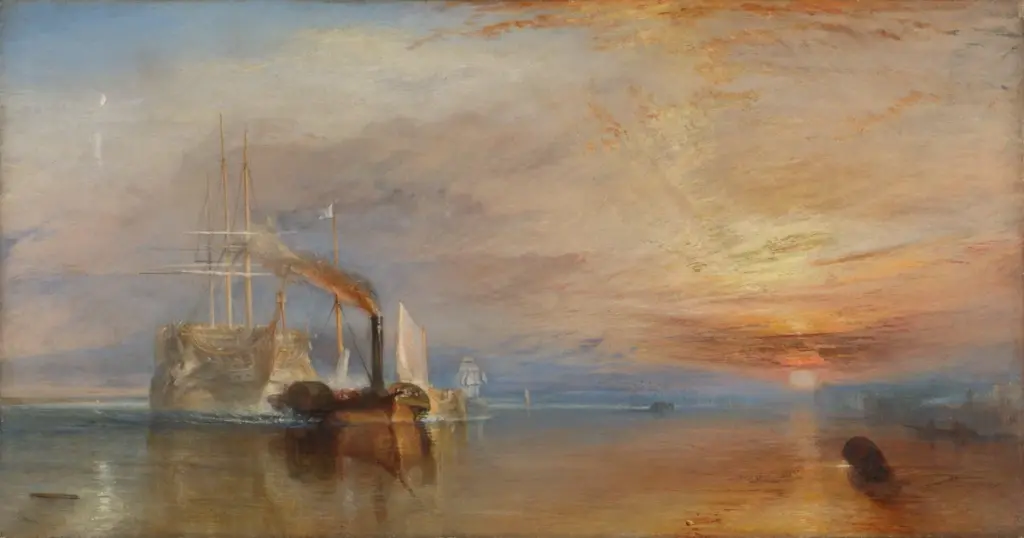
“And she’s fading down the river, But in England’s song for ever, She’s the Fighting Temeraire.”
Sir Henry Newbolt, The Fighting Temeraire
Some paintings seem to contain more than the subject they depict. J.M.W. Turner’s The Fighting Temeraire is one of them. The old warship, celebrated for her role in the Napoleonic Wars, appears almost ghostlike, still present and yet already fading into memory as she is towed towards her final berth. Turner himself could never bring himself to sell the painting. He referred to it as his “darling”. Some things mean too much to let go.
The Losses We Know How to Mourn
When we think of grief, we usually think of bereavement. The death of a loved one. The end of a marriage. Children leaving home. These are losses for which we have language, rituals and shared expectations. Patients often arrive in therapy with a loss they can explain. But there are many other losses that do not show up so obviously, they are less explicit, gradually woven into the fabric of our inner lives, so familiar we no longer recognise them as losses.
I once read that life is a daily confrontation with loss because each passing day is one we never retrieve. I have never forgotten the idea. Part of aging is precisely this gradual accumulation of absences. A wrinkle appears almost unnoticed. A body changes. A possibility closes without us noticing. Not every loss can be directly seen or articulated.
The Losses We Struggle to Name
Yet not all losses arrive through death or separation.
People grieve places, traditions, institutions, communities and ways of life. They grieve a sense of continuity between past and future. They grieve for belonging. They grieve futures they had assumed would unfold but never did.
Many people in the modern West describe the feeling that something important has changed, even if they struggle to articulate exactly what it is. We experience rapid technological change, such as the replacement of local newspapers and high-street shops with algorithm-driven feeds and vast online retailers, alongside increasingly fragmented realities that often leave little time to understand what is happening before something else changes again.
Such grief is difficult to recognise because there is no funeral for a declining institution, no ritual for a weakening sense of trust, and no socially sanctioned way to mourn the feeling that one’s country, community or culture has become unfamiliar.
When Grief Has Nowhere to Go
In the consulting room, these unnamed losses rarely sit in the shared world as grief or loss. Instead they may appear as disassociative numbness. Nothing feels real. They may appear as restlessness, despair or anger. In psychotherapy, patients often present with symptoms like anxiety, depression or overwhelm. But symptoms never tell the full story, which takes time to fully emerge.
What I hear is the pain of not knowing where home is anymore. The confusion about whether it’s wise to bring children into the world. The fear that the work they have spent decades mastering may disappear within a few years. They describe the loneliness of becoming disconnected from people, places, and things that once gave their lives coherence.
Naming a loss does not spare us from grieving it, but it does make it possible to think about and digest the experience, rather than becoming confined by it.
Attachment and Loss
Attachment theory reminds us that grief is not an abnormal reaction but the natural consequence of attachment. We mourn because we have loved, depended upon, or oriented ourselves towards something that mattered. Sometimes that attachment is to a person. Sometimes it is to a place, a faith, a community, a future, or even an imagined life that never came into being.
A patient whose father was sadistic and emotionally cold may slowly begin grieving not only the father she lost, but the loving father she never had. We can mourn possibilities as profoundly as realities. We can grieve relationships that never existed, children we longed for but never had, futures that never materialised, or versions of ourselves that were never given the opportunity to develop.
Our task as therapists is not to turn away from these experiences or dismiss them as nostalgia or resistance to change. It is to help patients recognise what has actually been lost, so that it can be thought about, mourned and integrated rather than acted out. In some cases, it may be to help them recognise something that is valuable and worth fighting for.
Beyond the Consulting Room
The same challenge exists beyond the individual.
Many people seem baffled by the polarisation and anger that increasingly characterise public life. Yet a society that cannot acknowledge what people feel they have lost will struggle to understand the demoralisation, resentment and social unrest that follow.
Anger is often easier to experience than grief. It preserves a sense of agency where sorrow confronts us with helplessness. In therapy, one task is to discover whether anger is the whole story, or whether it has been protecting something far more vulnerable beneath it. Sometimes this becomes clear in deeply personal ways.
Collective anger can certainly become destructive. It can spill into moral certainty, tribalism, violence and revenge. But denying it, pathologising it or criminalising its expression does not make it disappear. More often, it drives the feeling underground, where it becomes increasingly distorted.
Perhaps the more difficult question is not whether anger should exist, but whether we still possess institutions capable of understanding it and helping us think about what lies beneath it so we can correct course when we need to. What if the intensity of the reaction reveals a wound that many people feel nobody with authority is willing to acknowledge?
The Fighting Temeraire
I find it ironic that Turner called the painting his “darling” and that he could never bring himself to part with it. Perhaps that is why it continues to move us. Turner was not painting history from a distance. He was mourning something he himself could not bear to lose. The painting neither celebrates progress nor condemns it. It simply bears witness to the sadness that sometimes accompanies change, and to how difficult it is to watch the things we love disappear.
Perhaps our task is something similar: to recognise what matters, to mourn what should be mourned, to discern what is worth preserving and, where necessary, what is worth fighting for. Grief is not always a sign that we are resisting reality. Sometimes it is simply the measure of our attachment to it.
Sophie Frost is a psychodynamic psychotherapist, writer, and founder of The Primrose Practice, offering psychotherapy in English in Berlin. She works with individuals and couples, both in person and online, and writes about psychology, attachment, culture, and the emotional challenges of contemporary life.
Further Reading