
Psychodynamic therapy for ADHD, including support with executive functioning and emotional regulation, in Berlin and online.
Many adults begin to explore neurodivergence later in life sometimes through an ADHD diagnosis, sometimes through recognising autistic traits.
For some, this brings relief. For others, it raises more questions than answers.
As a psychodynamic, attachment-based therapist working in-person in Berlin and online, I work with both the realities of neurodivergent wiring and the relational and emotional patterns that often develop alongside it especially for those who grew up misunderstood, masked their inner world, or adapted to environments that did not fully see them.
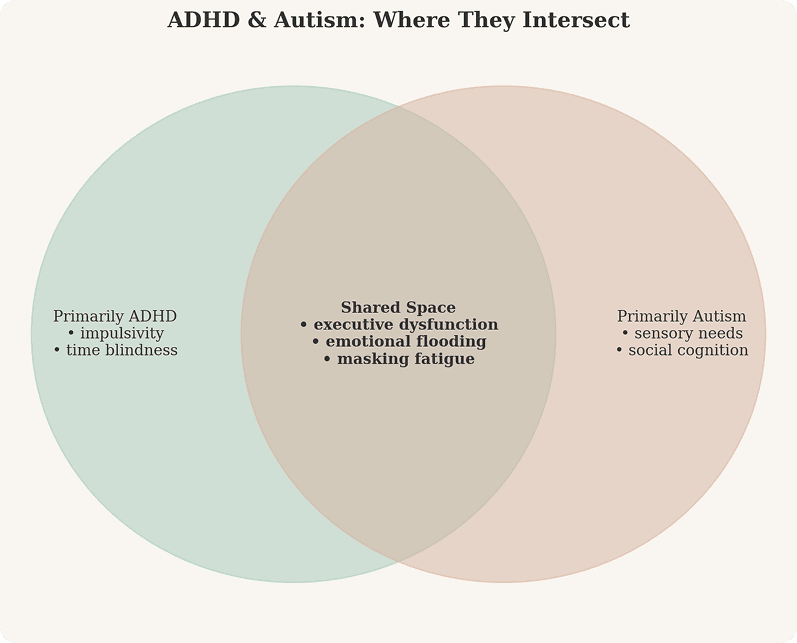
ADHD and autism are distinct diagnoses but in real life, they often overlap. Research suggests that many autistic adults also meet criteria for ADHD.
Many people navigate challenges with executive functioning, sensory sensitivity, or social overwhelm that do not fit neatly into one category.
For those with more internalised coping styles, this can mean years of adapting, masking, or quietly blaming themselves for difficulties that were never fully understood.
Difficulty with planning, organisation, or memory
Emotional overwhelm or reactivity
Difficulty starting or completing tasks
Sensory overload in stimulating environments
Feeling out of sync socially, emotionally, or cognitively
A nervous system under sustained stress
Unprocessed relational or attachment injuries
The effort of adapting to meet expectations
Long-standing patterns of self-criticism
You’re not making excuses, you’re beginning to understand yourself.
In therapy, we can:
Insight matters, but practical support is often needed as well. This work integrates depth-oriented therapy with concrete strategies, so emotional understanding can translate into everyday change.
Prioritising and organising tasks
Including sensory or emotional intensity
Completing tasks without burning out
Working with your energy, not against it
ADHD and autism are recognised neurotypes. For many, receiving a diagnosis brings clarity to patterns that once felt confusing or even shameful.
At the same time, diagnosis is not neutral. It can feel reductive, invasive, or misaligned with how someone understands themselves. A label can describe certain patterns but it does not capture the full complexity of a person’s inner world.
Whether you’ve been diagnosed with ADHD or autism, wonder if you might be on the spectrum, or simply feel your mind works differently, therapy can offer a deeper understanding of yourself.
You don’t have to figure it out alone.