
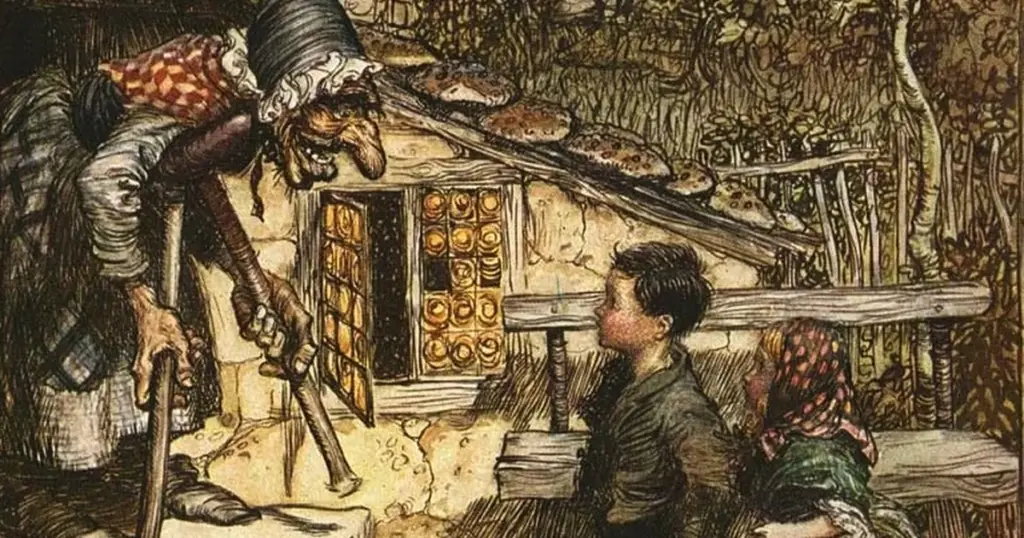
Fairy tales have never been particularly sentimental about women. The dark forests are populated by witches who lure children into their houses and devour them, stepmothers who abandon children in the woods, queens consumed by murderous envy. In Hansel and Gretel, the children escape one destructive maternal figure only to encounter another: first their stepmother who sends them into the forest, and then the witch who intends to eat them.
These stories survived for centuries perhaps because they gave symbolic form to something human beings have always known, but have not always found easy to acknowledge: the female is capable of destruction as well as creation.
The horrific case of Lindsay Clancy has brought some of this ancient and disturbing material very close to collective consciousness. I don’t want to comment extensively on the case itself, which I know only from a distance, but what has fascinated me instead is the collective response to it. Few things stir human passions more powerfully than the killing of children. When the person who kills them is their mother, something even more fundamental is disturbed.
I am always wary when an individual case becomes a lightning rod for a wider political conflict, and the Clancy case has certainly become that. On one side are commentators convinced that she is cold, calculating and remorseless. On the other are women who identify intensely with her suffering, sometimes projecting their own experiences of motherhood, vulnerability or psychiatric care onto her.
In both directions, the real Lindsay Clancy and her motives slip further away, a mere surface upon which we can project some of our deepest fears and convictions. I was thinking about this recently while listening to an excellent episode of This Jungian Life on the case and on maternal infanticide, which explored the archetype of the Death Mother and the darker dimensions of the maternal. Towards the end, the hosts asked what this case might be asking the collective to integrate.
My answer was slightly different.
Much of the discussion around maternal infanticide understandably concerns psychosis, despair, social abandonment and what is sometimes called altruistic infanticide: the mother who, within a profoundly disturbed or psychotic state of mind, believes that killing her children will somehow save them from suffering. There is, however, a form of female destructiveness that receives considerably less attention: destructiveness that cannot easily be explained through victimhood, maternal self-sacrifice or some adaptive function.
Years ago, while reading about female psychopathy, I became interested in the ways severe antisocial traits can manifest differently in women and men. Lydia Benecke’s Psychopathinnen, on female psychopathy, explores forms of manipulation, aggression and violence in women that are often directed towards intimate and familial relationships.
None of this tells us that Lindsay Clancy is a psychopath and I am certainly not suggesting that she is. But perhaps our greater comfort with understanding female violence through the lens of suffering points towards a larger psychological question: how willing are we to contemplate destructiveness in women in its own right?
Contemporary culture has become increasingly willing to discuss the destructive possibilities of masculinity. We are considerably less comfortable contemplating aggression, domination, cruelty and sadism in women. Female suffering is real. Male violence is real. But neither truth requires us to idealise women or to imagine female aggression only as the consequence of something done to them.
History contains mothers who killed while psychotic or profoundly desperate. It also contains women whose violence appears to have arisen from narcissistic, sadistic or other deeply destructive motivations.
The case of Marybeth Tinning is particularly disturbing. Between 1972 and 1985, nine of her children died, one after another. For years, explanations including genetic illness were entertained, even after the death of an adopted child made such an explanation increasingly difficult to sustain. Tinning was eventually convicted of murdering her ninth child, Tami Lynne, after she confessed to smothering her. She also reportedly confessed to smothering two of her other children, although those deaths remained legally unresolved.
If Tinning did murder her previous children, how did she manage to get away with it for so long? Perhaps it had to do with how difficult it was to contemplate the unthinkable: that maternal violence might be deliberate and concealed, and motivated by something other than altruism or psychosis. When compassion becomes idealisation, it can prevent us from seeing what is directly in front of us.
Perhaps, then, one thing the Clancy case has brought painfully close to consciousness is something of the female shadow. Our fairy tales, myths and old ballads, after all, seem to have understood something about this long before we did. The witch, the murderous queen and the devouring mother were not just aberrations from the imagination; they were expressions of the full range of possibilities within female nature.
To recognise the female shadow is not to diminish compassion for women, nor to deny the particular vulnerabilities of motherhood, but to allow that women, like men, contain the capacity for tenderness and destruction, sacrifice and selfishness, love and hatred.
A mature psychology must be capable of holding both.
Sophie Frost is a psychodynamic psychotherapist and founder of The Primrose Practice, offering psychotherapy in English in Berlin. She works with individuals and couples, both in person and online, and writes about psychology, attachment, culture, and the emotional challenges of contemporary life.
Further Reading
The Validation Trap: How Affirmation Therapy Threatens Depth
Inside the Manosphere: A Psychotherapist’s View on a Wider Relational Crisis