
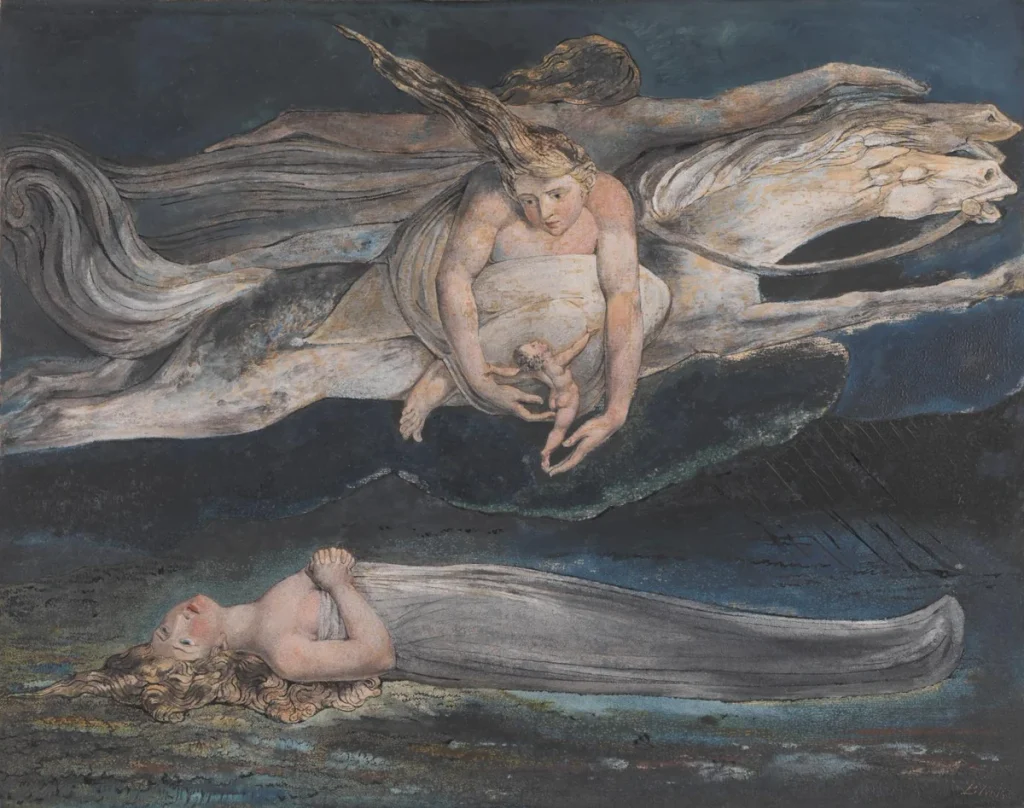
“I have conversed with the Spiritual Sun. I saw him on Primrose Hill.”
— William Blake, as recorded by Henry Crabb Robinson
I’ve been reflecting a great deal on the role of psychodynamic psychotherapy in our modern, techno-algorithmic, hyperreal world, and am in deep dialogue with these questions for a longer reflection in What’s Emerging: Questions and Musings.
In numerous discussions with patients and colleagues, I’ve returned to the idea that one of the increasingly important roles of psychotherapy may be to offer a break, or an interval, from the outside stream of duties, responsibilities, masks, optimisation, and pressures to conform and be certain. Identity itself seems increasingly under pressure to know itself, to declare itself, rather than be allowed to unfold through a process of growth and discovery over time.
Frequently, patients want me to provide answers, offer solutions, or tell them which way to go. Sometimes they become angry, frustrated or even mistrustful when I resist the pressure to do so.
Therapeutic neutrality has been heavily debated, but what does it actually mean? In my estimation, drawing on minds far greater than mine, it does not mean that I enter the therapeutic encounter without my whole self. Rather, it means holding that self in a state of continual reflection and discipline, resisting the temptation to impose it upon my patient, so that something original and true for them might emerge.
This is no easy task, particularly when the pressure upon therapists in the modern age is increasingly to occupy an almost guru-like position, to provide guidance, certainty and reassurance. To demonstrate that we are on the same side, that we belong together.
For many of us, the therapeutic space may be one of the dwindling places where we do not have to know, declare or conform. In the language of combat, I sometimes think of it as a kind of civilian space, where two people can encounter one another without having to take up arms. Opinions, identities, politics, doubts, fears and even the darker aspects of ourselves can be explored without the immediate pressure to defend or justify them.
Marion Milner, painter and psychoanalyst, wrote of the framed gap. Much like a picture frame that contains a world within it, the psychoanalytic setting marks out a different kind of reality from the one outside. The psychotherapy session becomes a kind of liminal space, set apart from the ordinary demands of time and the world. Perhaps even a sacred space, where something of our interior life can be encountered and come to be known.
When things are moving so rapidly, and we barely have a moment to stop, integrate or reflect, the therapeutic space may offer one of the few opportunities to catch our breath and meet the mind of another. It may also be one of those moments in time when the interior world is given its sacred due.
I lament that, in the digital age, so much of our lives are spent staring into screens, receiving an endless stream of information, images and demands upon our attention. I wonder what happens to our capacity for imagination, for reverie, for the discovery of our own interiority, when every interval is filled with something from outside.
William Blake understood imagination not simply as something we invent or consciously produce, but as something fundamental to our experience of reality. A world we might enter, rather than one we must continually construct.
Perhaps this is what an interval can offer us. Not merely a pause from the demands of the world, but the possibility of encountering something that cannot be summoned through effort, optimisation or certainty.
Something that might only emerge when we allow ourselves the space to see what happens.
Sophie Frost is a psychodynamic psychotherapist and founder of The Primrose Practice, offering psychotherapy in Berlin and online. She works with individuals and couples, both in-person and online, and writes about psychology, attachment, and the emotional challenges of contemporary life.